Studio Photography and Lighting by Christian Hough
Author:Christian Hough
Language: eng
Format: epub
Publisher: Crowood
Published: 2013-11-19T16:00:00+00:00
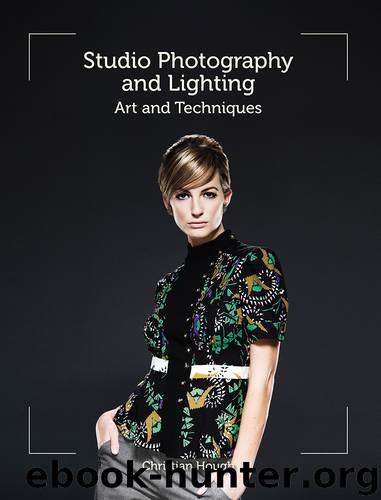
Fig. 3.6
Image © Christian Hough. Model: Kayt Webster Brown.
Getting Started
For this shot to work, it is important to find a smooth white background. A painted white wall, white paper or vinyl will work perfectly and allow the light to drop off smoothly, creating a gentle crease-free gradient. Of course, if you plan on converting the shot to black and white, it is possible to use any light coloured wall. The success of the background will depend on the available space, as the further away the background light is positioned from the wall, the greater the spread of light and the more subtle the gradient. Positioning the background light close to the wall or background paper will increase the angle at which the light needs to be placed and thus the contrast of the gradient.
Begin by attaching a light to a stand at waist height and fit it with a broad directional reflector. Position the light approximately 2–3 metres from the wall. Direct the light back towards the wall and use the modelling facility to ascertain the strength of the gradient. At 90 degrees, the light should be fairly flat on the background, however, as you position the light closer and decrease the angle, the contrast of the gradient will increase. Once you’re happy with the effect, meter the background light to approximately ƒ5.6 at the central point behind the model.
For the key and side light, it is a good idea to mark a position for your model on the ground and then use this as a reference point for your metering. Begin by positioning the attaching a reflector and honeycomb grid to a single studio light and placing this to the right side of the model. Position it approximately 1 metre higher than the model. This will be the key light so with your model in position, move the light around her until you achieve the familiar Rembrandt/short lighting pattern on the face and meter to ƒ11. Providing you keep the light the same distance from the model, it will be possible to move it around and shape the face, without the need to re-meter continuously.
Finally, attach a second honeycomb grid and reflector to a second studio light and position this to the left of the model. This will be used to light the shoulder and the hair. Position the light slightly behind the model and approximately 1 metre higher. The strength of this light will ultimately depend on the colour of the hair and skin of the model and you will find that darker hair and matt skin will need a little more power than fair hair and shiny skin, so meter between ƒ5.6 and ƒ11, making adjustments as necessary.
Download
This site does not store any files on its server. We only index and link to content provided by other sites. Please contact the content providers to delete copyright contents if any and email us, we'll remove relevant links or contents immediately.
Shoot Sexy by Ryan Armbrust(17788)
Portrait Mastery in Black & White: Learn the Signature Style of a Legendary Photographer by Tim Kelly(17052)
Adobe Camera Raw For Digital Photographers Only by Rob Sheppard(17031)
Photographically Speaking: A Deeper Look at Creating Stronger Images (Eva Spring's Library) by David duChemin(16735)
Bombshells: Glamour Girls of a Lifetime by Sullivan Steve(14136)
Art Nude Photography Explained: How to Photograph and Understand Great Art Nude Images by Simon Walden(13092)
Perfect Rhythm by Jae(5462)
Pillow Thoughts by Courtney Peppernell(4328)
The Book of Joy by Dalai Lama(4039)
Good by S. Walden(3603)
The Pixar Touch by David A. Price(3480)
A Dictionary of Sociology by Unknown(3114)
Fantastic Beasts: The Crimes of Grindelwald by J. K. Rowling(3086)
Stacked Decks by The Rotenberg Collection(2926)
Humans of New York by Brandon Stanton(2909)
Read This If You Want to Take Great Photographs by Carroll Henry(2738)
On Photography by Susan Sontag(2672)
Insomniac City by Bill Hayes(2595)
Photographic Guide to the Birds of Indonesia by Strange Morten;(2571)
